

How to Build an Indoor Climbing Wall for Kids
By Susan McBarnet, Co-Founder and Chief Play Officer of Wild Child. Susan is an ASID Associate member who designs and installs custom playrooms, climbing walls included, for families across the US.
Building an indoor climbing wall for kids comes down to five steps: choose a structurally sound wall, decide how big you want to go, plan a soft landing zone, mount panels to a frame, and add climbing holds. With modular panels, most families can do it themselves in an afternoon.
At Wild Child, we design and install climbing walls in playrooms across the country, and it's the feature kids ask for most. A good climbing wall turns a playroom into a destination: the room your kids run to after school, and the house their friends beg to come over to. Here's how we plan them, from choosing the right wall to picking the holds.
Why a climbing wall is worth it
A home climbing wall gives kids the big-body movement they're already looking for, and it builds the grip and core strength they rely on at school, along with problem-solving skills and confidence.
It's made for sensory seekers
You know the kid. They crash into the couch cushions, launch off the arm of the sofa, and go off the diving board 40 times in a row. That's not misbehavior. They're seeking proprioceptive and vestibular input, the deep pressure and movement their bodies crave. A climbing wall over a soft landing zone gives them a place to get it, safely and on repeat, so your furniture gets a break.
It builds hand and grip strength
Every reach and pull on a climbing hold works the small muscles of the hands and fingers. That grip strength supports the fine motor tasks kids face at school, like holding a pencil, handwriting, and cutting with scissors.
It builds core strength
Climbing is a full-body workout, and much of it happens in the core. A stronger core helps kids sit upright for longer, whether that's circle time in preschool or a desk in elementary and middle school.
What a pediatric occupational therapist says
“The benefits of climbing are many! Climbing not only improves grip and hand strength, but it also improves shoulder, core, and overall body strength. Climbing develops motor planning and problem solving as children need to figure out where to make their next step and how to use their bodies to get there. Climbing also possesses an element of risk that has been removed from too many of today’s play-based activities. When a child participates in play that has an element of risk, it builds self confidence, resilience, and creativity/innovation!”
— Heidi Tringali, MS, OTR/L, pediatric occupational therapist and founder of T.O.T.S., Tringali Occupational Therapy Services.
What do you need to build an indoor climbing wall?
With Wild Child's modular climbing wall panels, you need three things: the panels, climbing holds, and a soft landing zone. Each panel comes ready to hang, with everything you need to mount it:
A 47" x 23.5" birch panel with 18 T-nuts pre-installed. T-nuts are the threaded inserts your climbing holds bolt into.
Its own mounting frame, which attaches to the wall first. The panel then mounts onto the frame.
Panel connector screws. These attach each panel to its frame.
A detailed installation manual.
Then add:
Climbing holds, sold separately. Bolt-on holds thread into the T-nuts and can be moved anytime.
A landing zone, like a foam pit or landing pad under the wall.
You'll also need basic tools: a drill or impact driver with bits for your screws, a stud finder, a level, a tape measure, a pencil, a step ladder, and an Allen key for the holds. To attach the frames, use structural screws rated for your wall type.
What type of climbing wall is best for kids?
The best type depends on your space, your kids' ages, and how much building you want to do. There are three main options for indoor climbing at home.
| Type | Best for | Effort to install | Grows with kids? | Space needed |
|---|---|---|---|---|
| DIY plywood wall | Handy families who want full control | High: cutting, drilling, and installing every T-nut | Yes, with bolt-on holds | A dedicated wall |
| Modular climbing panels | Families who want a custom wall without building panels | Moderate: mount frames, attach panels, add holds | Yes: move holds and add panels | A dedicated wall, sized to fit |
| Freestanding climber | Toddlers and rooms where you can't drill | Low: assemble and set down | Limited: sized for young kids | Floor space; can be moved |
Freestanding climbers, like climbing triangles and arches, are a great first climbing experience for toddlers. Most kids outgrow them by the time they want a real challenge. A wall-mounted climbing wall, whether you build it from plywood or use Wild Child's modular panels, is the option that keeps working as kids grow from preschool through the tween years.
Prefer to build from scratch?
You can build your own climbing panels from plywood. It's doable, but it's the most labor-intensive way to get a climbing wall. You'll cut the plywood to size, drill a grid of holes, hammer a T-nut into the back of every hole, sand and finish the face, then build a frame to mount it all.
The T-nuts are the hardest part. Each one is installed by hand, and once the panel is on the wall, you can't reach one that's crooked or spinning. Wild Child's panels arrive with T-nuts pre-installed and their own mounting frame, so you can skip straight to hanging your wall.
Which wall should you use for a climbing wall?
If your room allows it, put the climbing wall in a corner. Kids love to perch up in a corner and drop down into the landing zone, and a corner wall gives them two planes to climb and a natural summit to reach. It also tends to use space that would otherwise sit empty. If you're planning a corner wall, locate the studs on both walls before you commit, since each panel's frame needs to cross at least two studs.

We placed this family’s climbing wall in the corner so the kids could take advantage of both walls as they climbed on up!
Make sure the wall can take the load
Your wall needs to handle the weight of whoever is climbing, plus the forces of pulling and jumping. Our panels can be mounted on wood studs, metal studs, concrete, or CMU (concrete block). Each panel supports up to 270 pounds, so grown-ups can climb too. If you're unsure what's behind your drywall, find out before you drill. Brick and stone veneer aren't suitable mounting surfaces.
Plan around the rest of the room
A few design considerations we work through on every project:
Windows and doors. Keep the wall and its landing zone clear of door swings and away from windows.
Sightlines. Place it where a grown-up can see it from where they naturally sit.
Play zones. Think about how the wall connects to everything else. A wall that feeds into a foam pit, monkey bars, or a cargo net becomes part of a bigger adventure, not a standalone feature.
How big should a kids' climbing wall be?
Most home climbing walls we build use between 3 and 16 panels. Each Wild Child climbing wall panel measures 47" x 23.5", so you can map out your wall on graph paper or with painter's tape before you order.
Here's what different sizes look like in real playrooms:
| Size | Panels | Example |
|---|---|---|
| Compact | 3 | Alabaster White panels in a sunny playroom |
| Medium | 6 | Alabaster White panels in a basement playroom |
| Large | 9 | Natural birch panels around an 8' x 5' foam pit |
| Extra large | 16 | Birch panels with a foam pit and monkey bars |
Even three panels gives kids plenty to climb. Because the panels are modular, you can start small and add more later.
Planning your panel layout
Each panel is roughly 2' x 4', and panels can't be cut to fit, so plan your wall in full panels. You can hang them horizontally or vertically, and you can mix both on the same wall.
Walls 2, 6, or 10 feet wide need at least one column of vertical panels.
Walls 4, 8, or 12 feet wide can go horizontal, vertical, or a mix.


Small, medium and large climbing walls in real client homes
How much does an indoor climbing wall for kids cost?
Wild Child climbing wall panels are $275 each, including the mounting frame, pre-installed T-nuts, and hardware, with free shipping in the continental US. That puts a compact 3-panel wall at $825 in panels and an extra-large 16-panel wall at $4,400, before holds and a landing zone. Your total depends on three things: how many panels you need, how many holds, and what goes underneath.
| Wall size | Panels | Panel cost | Holds | Estimated total |
|---|---|---|---|---|
| Compact | 3 | $825 | 18–30 holds (2–3 packs): $300–$450 | $1,125–$1,275 |
| Medium | 6 | $1,650 | 36–60 holds (4–6 packs): $600–$900 | $2,250–$2,550 |
| Large | 9 | $2,475 | 54–90 holds (6–9 packs): $900–$1,350 | $3,375–$3,825 |
| Extra large | 16 | $4,400 | 96–160 holds (10–16 packs): $1,500–$2,400 | $5,900–$6,800 |
Add a foam pit or landing pad to complete the setup.
Is it cheaper to build your own?
Building panels from plywood can cost less in materials, roughly [price] per panel for plywood, T-nuts, and hardware. The trade-off is time: every panel needs cutting, drilling, and dozens of T-nuts installed by hand. For many families, pre-built panels are worth it for the hours they save.
How high does a kids' climbing wall need to be?
A kids' climbing wall doesn't need to be tall to be fun. We don't build walls that go more than 8 feet above the ground or the landing surface, and most land between 6 and 8 feet.
Here's the secret: most kids use a climbing wall as a way to climb up and drop into the foam pit. The thrill is the drop, not the height. So a moderate wall over a great landing zone beats a tall wall every time.
How high does my ceiling need to be for a climbing wall?
You need a ceiling of at least 7 feet. What matters most is the distance from the landing surface to the top of the wall, which we keep to 8 feet or less.
That means taller ceilings work too, as long as your landing zone brings the floor up. For example, with 10-foot ceilings and a 2-foot-deep foam pit, an 8-foot wall is right on target.
In practice, ceiling height decides how you stack the panels:
Ceilings under 8 feet: stack three panels horizontally for a wall about 6 feet tall.
Ceilings 8 feet or higher: stack four panels horizontally, or two vertically, for a wall just under 8 feet tall.
Can the panels go vertically?
Yes. Panels are most often installed horizontally, but you can turn them vertical to fit an unusual room. In this playroom, we mixed vertical and horizontal panels to make the most of the space.
What goes under a climbing wall?
Every climbing wall needs a soft landing zone that covers the whole area kids might jump or fall into. Your two best options are a foam pit or a landing pad.
A foam pit is the ultimate landing zone. Kids climb up and drop in, again and again. It's a favorite in our larger installs. Shop foam pits.
A landing pad works well for compact walls and smaller rooms. The CalmCrasher Landing Pad gives kids a cushioned spot to drop down and doubles as a sensory crash zone.
Whichever you choose, make sure it extends beyond the edges of the wall, not just directly underneath it.
How to install climbing wall panels, step by step
With a frame-mounted panel system, installation needs only basic tools: you mount the frame first, then the panel attaches to it. A second person to hold frames and panels in place makes the job much easier.
Map the layout. Mark the wall's outline with painter's tape so you can see the size and position before you drill. Panels can't be cut, so plan in full panels. If an outlet falls behind the wall, have it disconnected, the wires capped, and a flat cover plate installed first.
Find your studs or confirm your wall type. Use a stud finder on drywall and mark the center of each stud. Concrete and CMU walls need masonry fasteners.
Mount the frames. Attach each panel's mounting frame to the wall first. Each frame should cross at least two studs, with screws driven into the center of each stud. Butt the frames against each other so the edges are flush. On concrete or CMU, use at least four fasteners per frame.
Attach the panels. Set each panel on its frame and secure it with the included connector screws.
Add the holds. Bolt climbing holds into the T-nuts. Plan your route before you tighten everything down.
Set up the landing zone. Put your foam pit or landing pad in place before anyone climbs.
Test and check regularly. Pull hard on every hold before the first climb, and recheck holds and fasteners once a month.
Every panel comes with a detailed installation manual.
Are indoor climbing walls safe for kids?
Yes, when they're installed properly and planned with a good landing zone. These are the safety rules we follow on every Wild Child climbing wall:
Keep it to 8 feet. The top of the wall should be no more than 8 feet above the ground or the landing surface.
Cover the whole fall zone. Your foam pit or landing pad should extend past the edges of the wall, not just sit directly underneath it.
Mount into structure. Anchor the frames into studs, concrete, or CMU, never drywall alone.
Check the holds. Make sure every hold is tight before the first climb, and recheck once a month. Bolt-on holds can loosen with use.
Keep the landing zone clear. No toys, furniture, or hard edges below the wall.
Supervise young climbers, especially while they're learning.
Deal with outlets first. Never leave a live outlet behind a climbing wall. Have it disconnected, the wires capped, and a flat cover plate installed before the frames go up.
How should you place climbing holds for kids?
Place holds closer together for younger climbers, and spread them out as kids get stronger. Plan on 6 to 10 holds per panel. With 18 T-nuts on each panel, there's plenty of room to reset the route whenever you like.
Start with an easy route. Plenty of big, grabbable holds help new climbers build confidence.
Add a challenge over time. Smaller holds and longer reaches keep older kids interested.
Change it up. A new route makes an old wall feel brand new, so your climbing wall grows with your family.
Bolt-on vs. screw-on climbing holds
There are two types of climbing holds, and the difference matters for how your wall grows.
Bolt-on holds attach with a bolt that threads into a T-nut on the back of the panel. You can unbolt them and move them anytime, so you can change the route as your kids get stronger. All Wild Child climbing holds are bolt-on.
Screw-on holds attach directly to the wall surface with screws. They're a simpler option for a DIY wall without T-nuts, but once they're in, they stay put. Moving one means new screw holes.
If you want a wall that keeps challenging your kids for years, bolt-on holds and T-nut panels are worth it.
Holds are also a design element. Color can tie the wall into the rest of the room, whether that's a tonal palette or a full rainbow. Our 10-pack of climbing holds is a great starting point, and our designer 30-pack comes in curated color combinations.
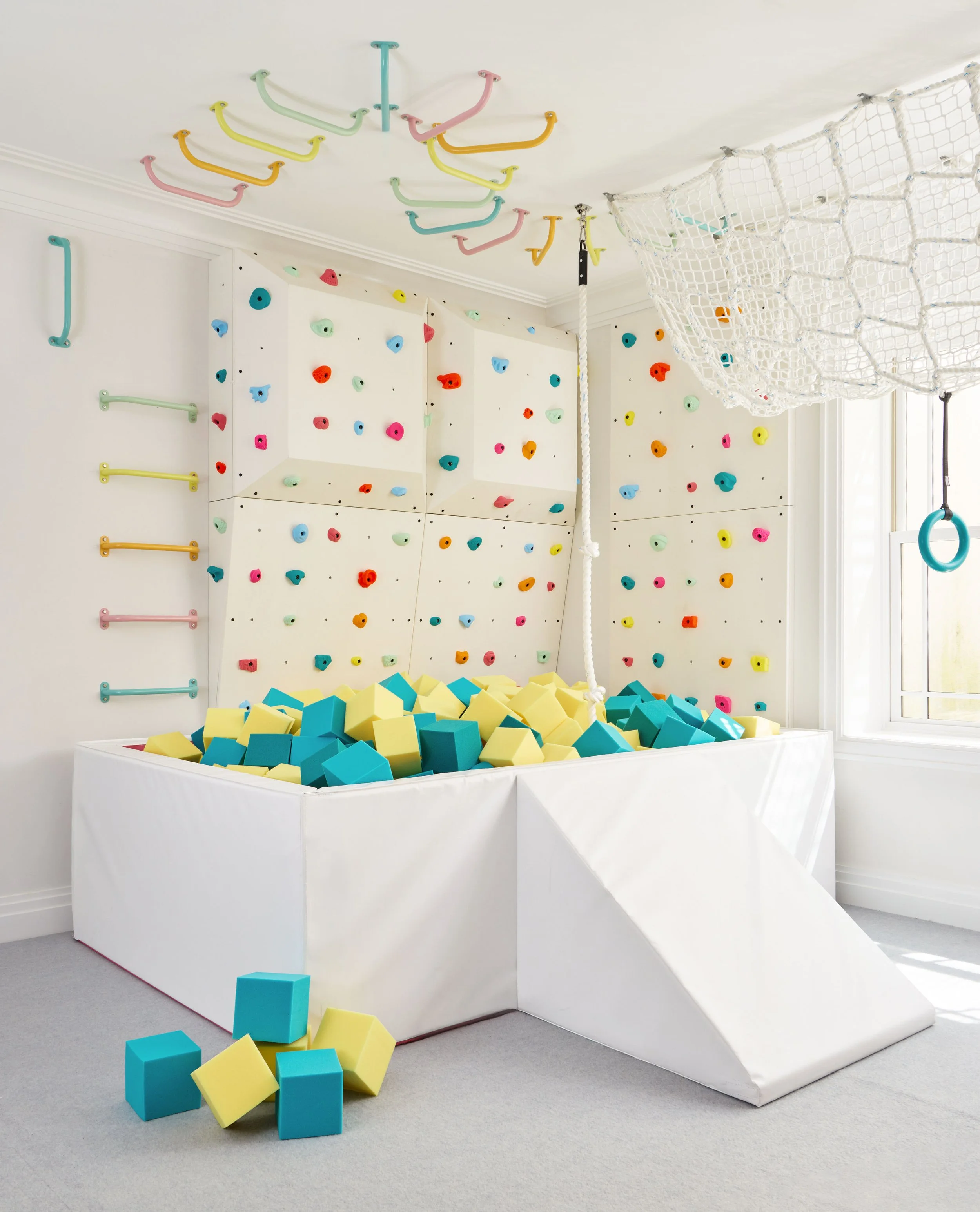
A fun pop of color for this fun playroom for two sisters who love to be active!
Can you paint climbing wall panels?
Yes. Our Alabaster White panels come paint-ready, so they're the best choice if you want a custom color or mural. If you'd rather keep a clean, modern look, the Natural Birch and Owl Gray finishes work beautifully as-is.
A few painting tips from our installs:
Use a low-sheen floor and patio paint. It's made to handle wear.
Plug the T-nuts first. Press soft foam earplugs into the T-nut holes so paint doesn't clog the threads, then pull them out once the paint dries.
Go easy on coats. Each layer of paint softens the panel's grip texture, so use as few coats as you can.
Should you DIY it or hire a playroom designer?
If you're handy and want a climbing wall on its own, you can absolutely do it yourself. Our panels were designed to be DIY-friendly.
It's worth bringing in a designer when the climbing wall is one piece of a bigger plan. That might mean combining it with monkey bars, a cargo net, or a foam pit, working with an awkward room, or designing the whole playroom so everything flows together.
Anywhere in the US: our E-Design service gives you a complete plan, remotely.
Near Westport, CT or Dallas, TX: our full-service team designs and installs the whole space.
Get started and tell us about your space.
Frequently asked questions
What age is a climbing wall good for?
With supervision and support, we’ve seen kids as young as one year old start to pull up on a climbing wall. Kids of all ages benefit from climbing walls and they remain relevant over time since you can change up the route by adding or removing climbing holds.
How much weight can climbing wall panels hold?
Each of our panels supports up to 270 pounds, so it's sturdy enough for kids and grown-ups alike.
Can I put a climbing wall in a rental?
Panels mount into studs or masonry, so installation leaves holes in the wall. Get your landlord's permission first, and plan to patch and paint when you move out.
Can I add more panels later?
Yes. The panels are modular, so you can start with a compact wall and expand it as your kids grow.
How long do climbing wall panels take to ship?
Our panels ship in about 1 to 2 weeks, and shipping is free in the continental US.
